Factory stock · built for cladding
Factory stock, costed to the job that uses it
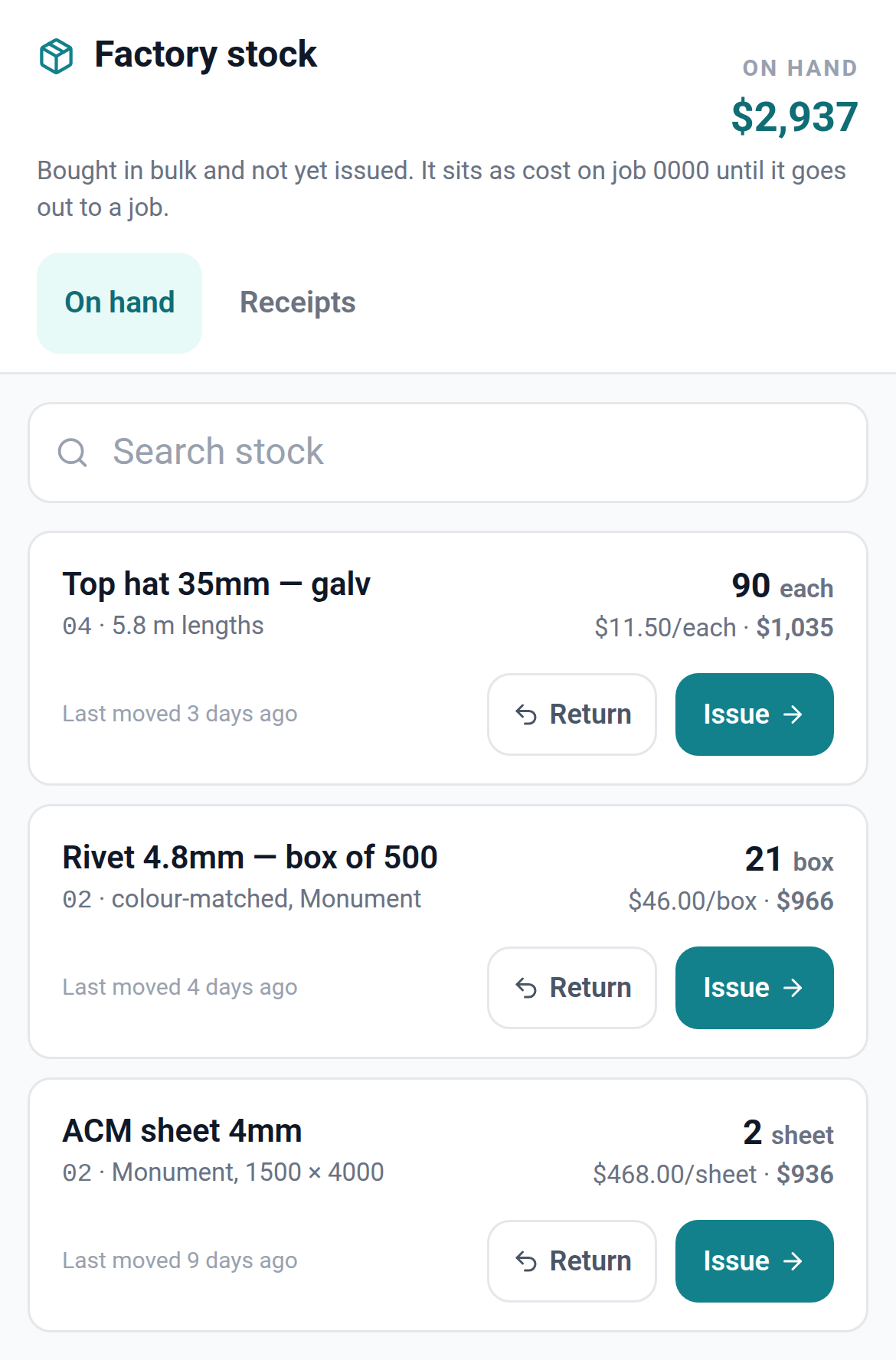
Buy top hats, rivets and ACP sheet in bulk, then send them out to jobs from a phone in the yard. Each issue puts its cost on that job’s budget, under the right cost code, at the price you actually paid — freight included. No stock app on the side, and no invoice typed in twice.
Off until you switch it on — it’s there for the subbies who hold stock.
How it works
Bought once, costed to every job it goes to
The worked example is the app's own: 100 top hats for $1,000, $150 of freight, and 10 of them sent to one job.
01
Receive it, with the freight shared out
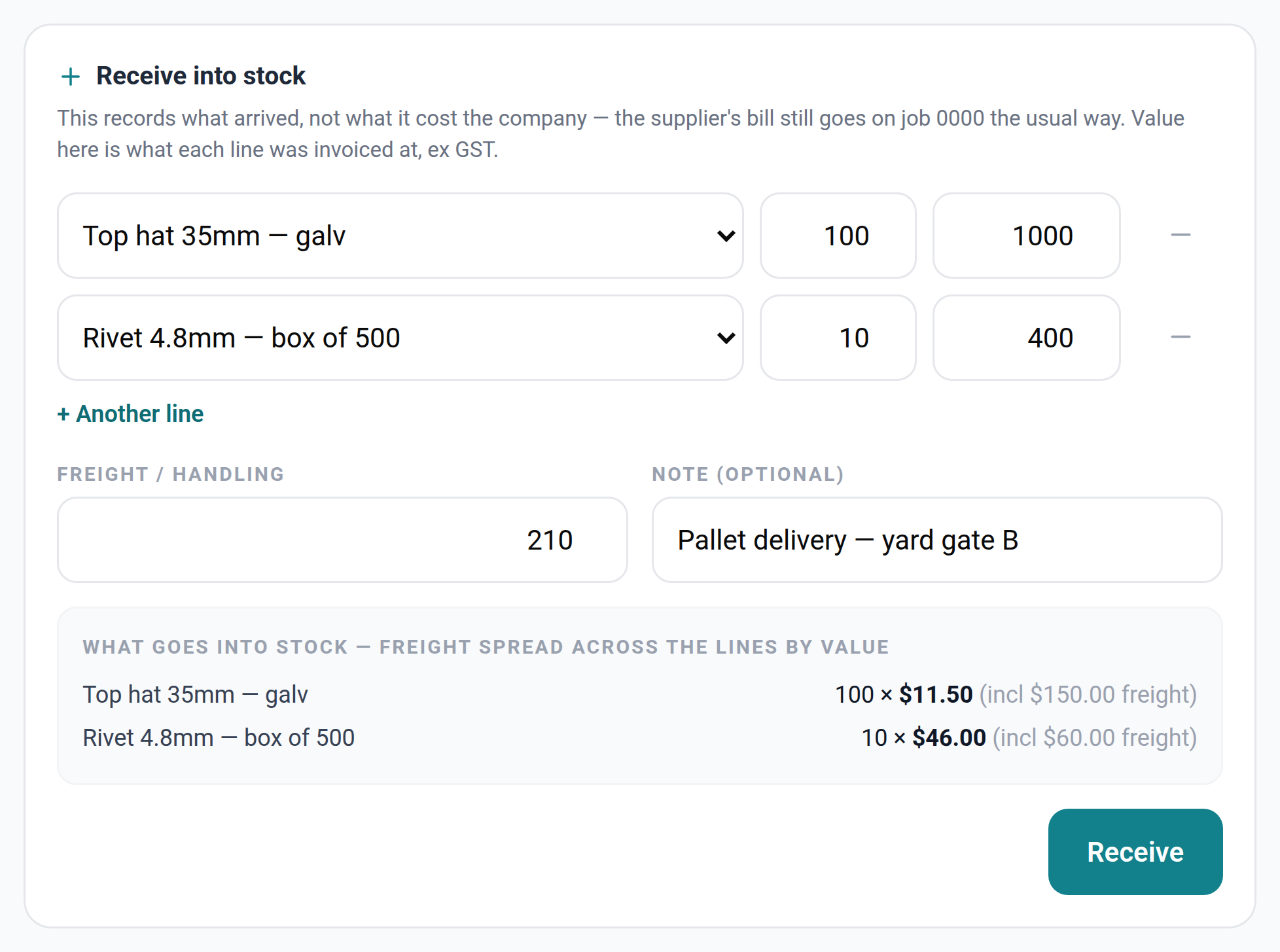
Enter the delivery line by line, and the freight is spread across the lines by value before you save. 100 top hats at $1,000 plus $150 of delivery come out at $11.50 each — the price every job that uses one will be charged.
02
Issue it to the job from your phone
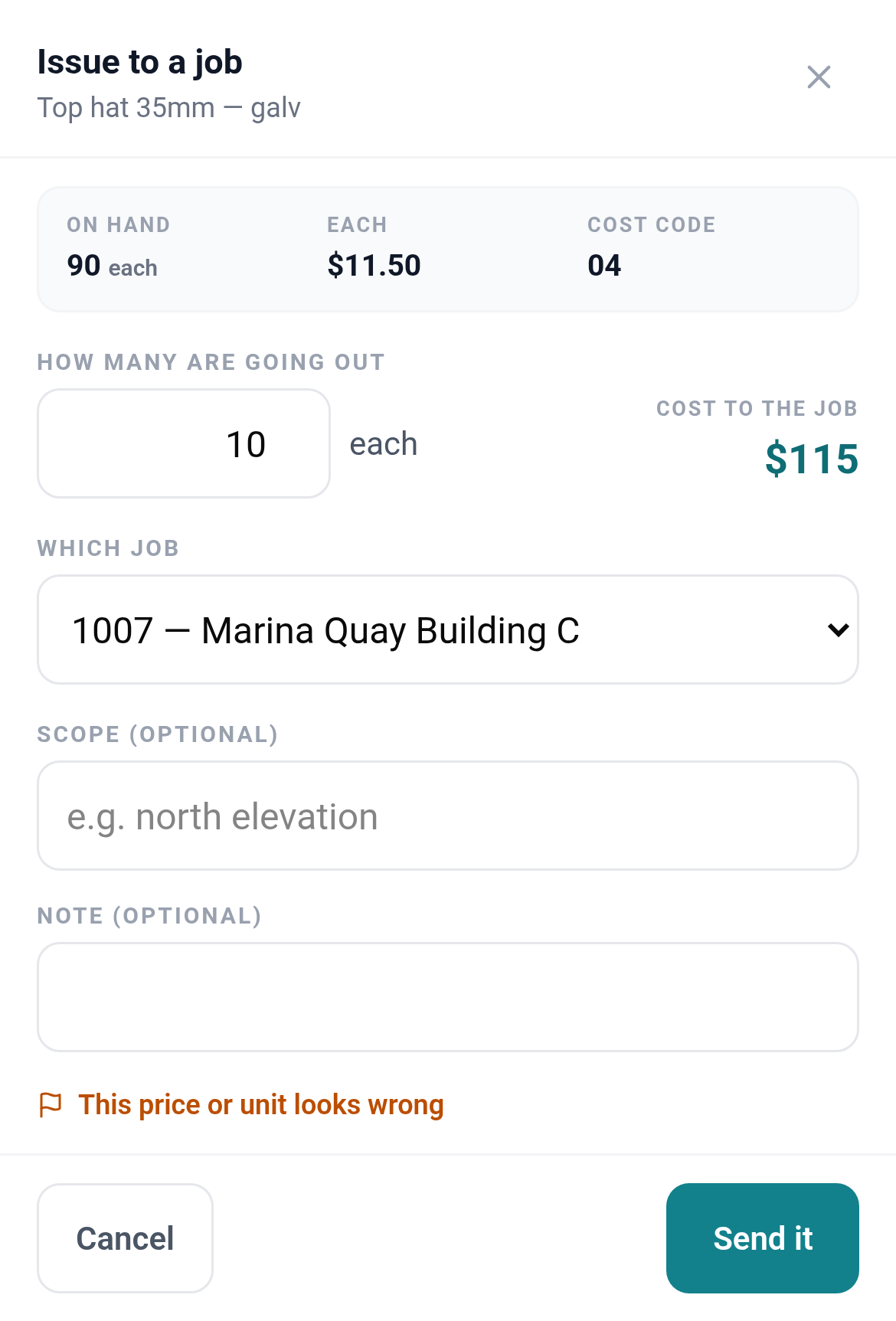
Pick the item, the quantity and the job. Send 10 top hats to job 1007 and $115 lands on its budget under cost code 04, at the average price on the day — fixed from then on. Too many went out? Return them and the job gets the cost back.
03
Know what’s in the yard
What’s on hand, what it’s worth and how long since each item moved. A stocktake correction needs a written reason, a wrong price can be flagged on the spot, and Data health warns when stock gets ahead of the bills behind it.
Questions
What the office asks before switching it on
How is the freight spread across a delivery?
By value. 100 top hats at $1,000 with $150 of delivery come out at $11.50 each, not $10.00. On a mixed delivery each line carries its share of the freight in proportion to what it cost — the landed cost — and you see the split before you save.
Doesn't that count the supplier's bill twice?
No. The bill for bulk stock goes on your factory job the usual way, and the stock sits there as cost until it goes out. Issuing it to a job is a transfer: the cost lands on the job and the same amount comes off the factory, in one record. Across the company it nets to exactly zero.
What price does the job get charged?
The average price of what's on hand, including freight — fixed on the day the stock goes out. A later delivery at a different price doesn't quietly restate what an old job was charged.
What if too much goes out, or the count is wrong?
Return the extras and the job gets the cost back. A stocktake correction needs a written reason before it saves, and it never lands on a job — a write-off stays with the factory, where Data health points it out instead of burying it.
Does it warn me when stock runs low?
Not yet. Today it shows what's on hand, what it's worth and how long since each item moved. Low-stock alerts, offcuts and more than one store aren't in it yet.
We don't hold stock. Will it get in the way?
No — it's off until someone switches it on in Settings, and until then there is no factory job, no stock menu and nothing to ignore.
Stock is one line of the job’s cost — the budget also carries the orders, the bills and the crew’s hours. See how the money side works.
Bring your stock list
Thirty minutes. We set up three of your own items, receive a delivery and send some to a job — and you can see what it did to that job's budget.
No obligation, no card — thirty minutes on a job of your own.