Everything from the first takeoff to the final claim
31 tools across 9 areas, one source of truth. Estimating and job costing the way subcontractors actually work — not the way head contractors do.
01 — 5 tools
Price it
Everything between the invitation landing in your inbox and the proposal going back out — on your rates, in your cost codes, with a record of every price you have ever sent.
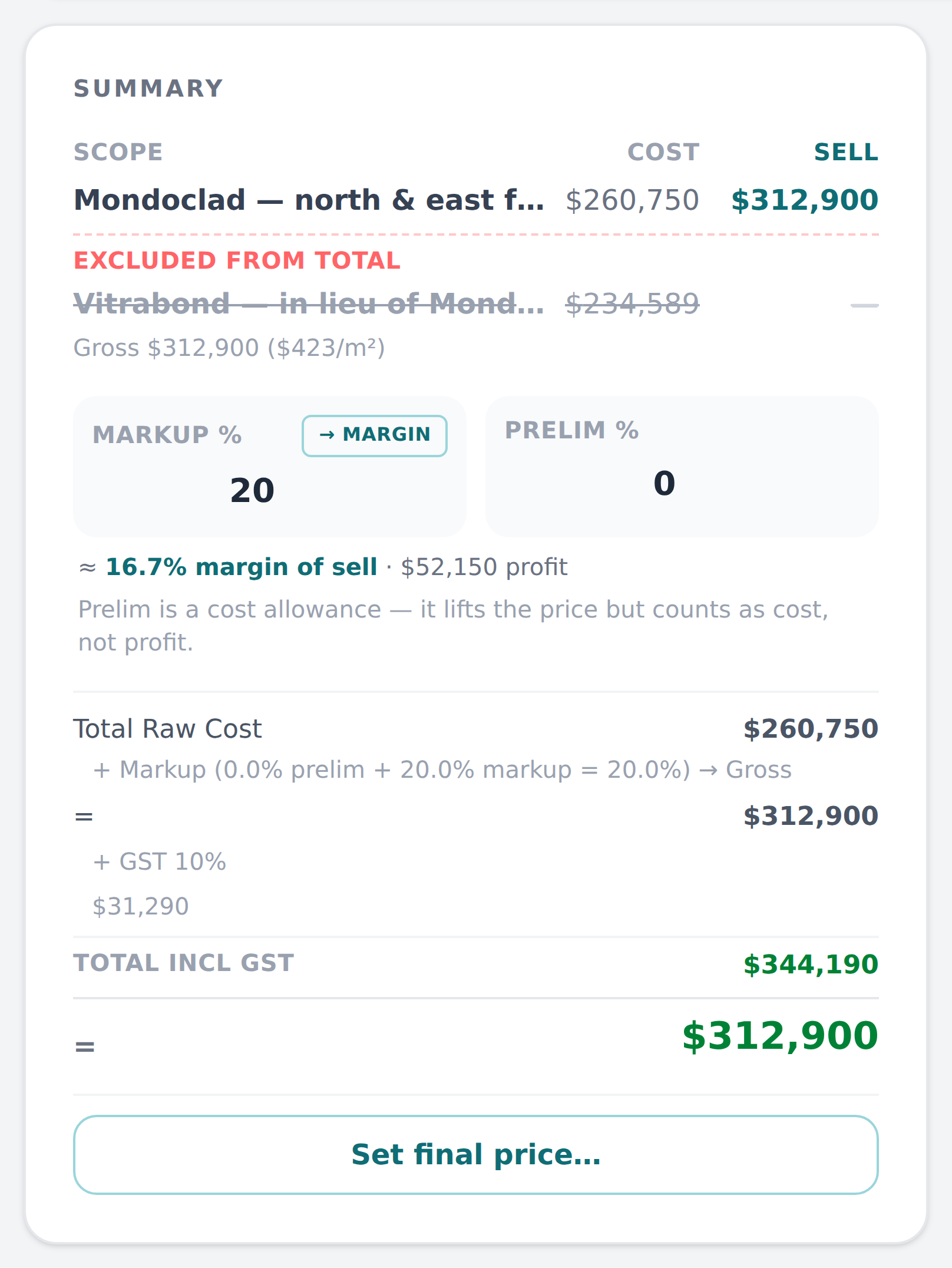
Cost, sell and the margin between them, on every scope — including the alternative you priced and did not win, which stays on the job.
The cost sheet
Labour, material, subbie and hire rates under your own cost codes, with waste, preliminaries and margin applied across the lot. Type a formula in a quantity cell and it works — quantities follow the scope, so changing one number moves everything built on it.
Your takeoff quantities live on the priced revision
Measurements are held against the scope they belong to, inside the revision you priced — so a drawing change cannot leave the cost sheet quoting an area nobody measures any more. Name a measurement once and every line built on it follows, and last year's revision keeps the quantities it was actually priced against.
Proposals out of the same screen
The client-facing document is built from the estimate you just priced — scope descriptions, terms, your options — and goes out as a branded PDF on your own email template. Not a second document to keep in step.
Every price you have ever sent
Full revision history per job. When a variation gets argued eight months later you can put Rev 2 on the table with its date and the drawings it was priced against — instead of hunting through Quote-FINAL-v7.xlsx.
Bring your existing work across
Import your jobs, contacts, purchase orders and bills from a spreadsheet rather than starting from zero. Coming off Buildertrend, export those four and paste them into the template — your rates and your cost codes come with you, and that is the part worth keeping.
02 — 4 tools
Chase it
Most of a subbie's week is not one job at one stage. It is a dozen prices sitting out there waiting on somebody else, and remembering which one needs a phone call today.
The board
Every job from invitation to awarded on one board, so you can see at a glance what is priced, what is submitted and what is still on your desk. Drag it across when it moves; the job keeps its whole history.
Follow-ups that stay on the job
Dated notes against the job itself, in order, with the next step and who owns it. Back-date one you did last week and it lands where it belongs rather than at the top. Deleted ones go to the recycle bin, not into thin air.
Follow up by voice, from the ute
Tap the mic and say what happened — “the Kingsway job needs a variation, Sofia is on it next week”. It works out which job you mean, writes the note, sets the next step with a date and assigns it. Nothing is saved until you read it back.
What did we charge for this last time?
Search every costed line you have ever priced by material, supplier or description, and see the rate on each job that carried it — the material rate separately from the installed rate, because they are different numbers and only one of them is comparable.
03 — 6 tools
Run the money
The day you win, the estimate stops being a quote and becomes the budget. Everything you order and every invoice you receive lands against it, cost code by cost code.
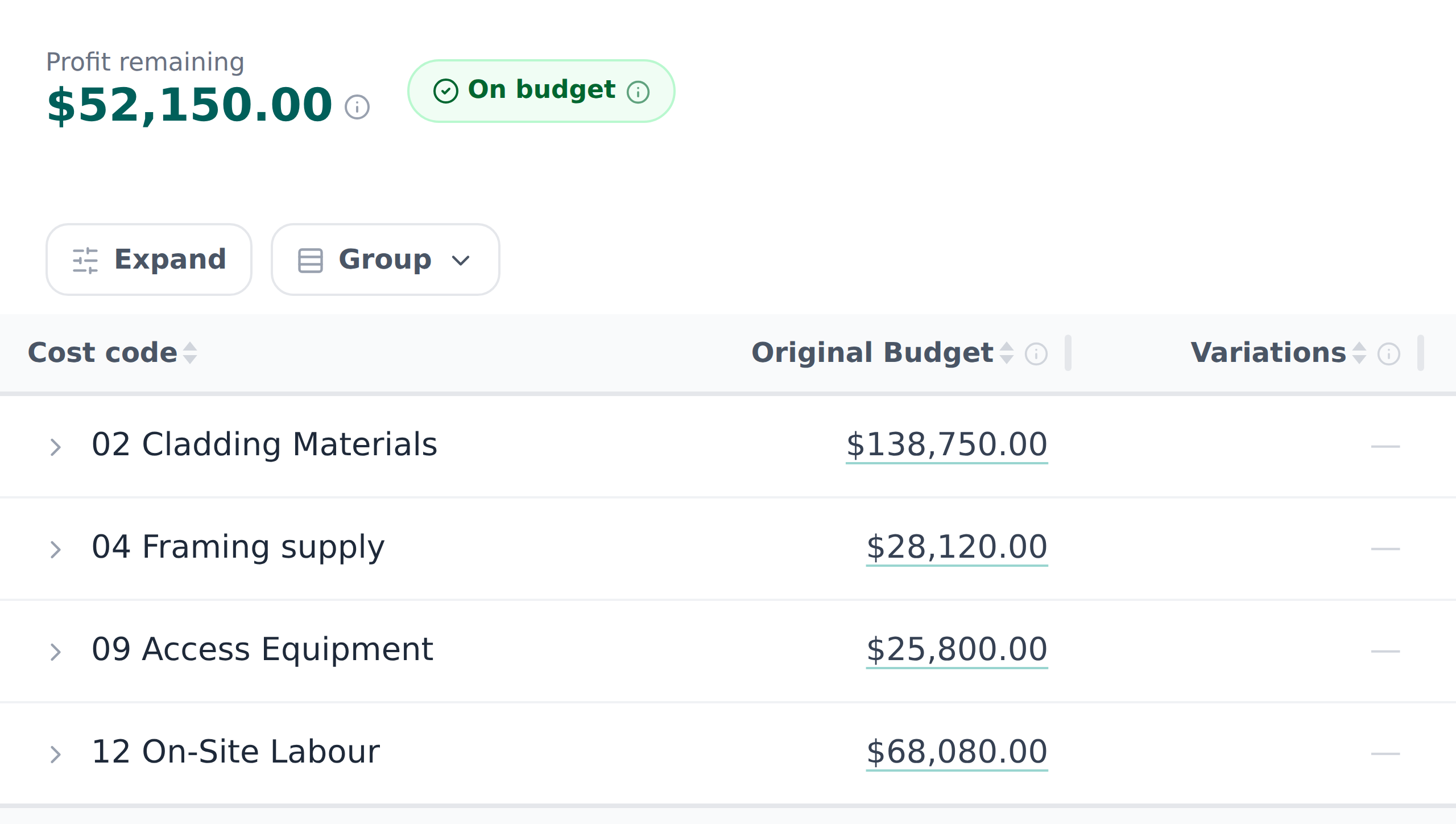
The budget you track is the estimate you won, cost code for cost code. Nothing was re-typed to get here.
Awarded → the budget is already there
Winning the job seeds its budget from the winning revision, per cost code, in one click. This is the re-typing that used to take an afternoon and quietly introduce the error you would find in month three.
Forecast final cost, while you can still act
Budget → Committed → Actual → Forecast on every cost code, with variations against the contract. You find out a code is sliding in the week it happens, not when the job closes out and the number is already spent.
Orders and RFQs
Raise an RFQ to a supplier, turn the answer into a purchase order against a cost code, and the committed cost is on the job the day you order — not the week the invoice turns up. Independent PO and RFQ numbering per job.
Drop the supplier's quote on the RFQ
Their quote comes back as a PDF, or as three screenshots of an email. Drag them onto the RFQ and the line items, quantities, unit rates and the GST come back read out and sat beside your own allowance, so you can see where they differ before anything is filled in.
Master orders and draw-downs
One supply agreement for the job, drawn down in batches as the work needs it, with each release tracked against the master. For the trades where you buy the package once and call it up over months.
Bills that fill themselves in
Drop the supplier invoice in and the supplier, invoice number, amount and due date come back filled in against the right cost code, linked to the order it belongs to so nothing gets counted twice.
04 — 4 tools
Get paid
Claiming what you have earned, when you have earned it — including the work that was never in the original contract.
Progress claims against the contract
Claim by percentage complete against the same scopes and cost codes you priced, with the split a builder expects to see: original contract sum, approved variations, contract sum to date. The schedule of values is frozen when you claim, so last month's claim stays what it was.
Variations, priced and tracked
Price a variation off the job's own rates and markup, send it to the builder, and track it from submitted to approved with the date and who approved it. Approved ones flow into the next claim as their own line instead of being remembered.
A link the builder can just open
Send a variation, an order or a claim as a secure link. They open it, see only what you shared, and approve or decline it there — no account, no login, no PDF chain. Their answer lands back on the job with a timestamp.
Over- and under-billing across the book
Work in progress across every live job: what you have earned against what you have actually billed. The number that tells you whether the business is funding the builder or the other way round.
05 — 5 tools
Run the site
The crew, the programme and the paperwork — with everyone seeing exactly what they should and nothing they shouldn't.
Time clock, against the scope
The crew clocks on to a job and a scope from their phone, and the labour cost lands on the right cost code that day. Split shifts, overtime at your own rate, and a supervisor approves before it counts. An approved shift is frozen.
The site diary
One log per job per day — who was on, what happened, weather, delays, photos from the phone. Two people can write the same day without one wiping the other, and every entry says who wrote it and who edited it.
Drawings, versions and approvals
Project files with real version history — a superseded drawing stays superseded, and the current one is obvious. Shop drawings go out for approval and come back with the answer against them.
The programme
Gantt and calendar views of the job, seeded from the estimate's own scopes so the programme starts from what you actually priced. Already have it in Excel? Bring it in.
Tasks that reach the right person
Assign work with a due date, on the job it belongs to. Everyone gets their own list, notifications when something lands, and a digest so nothing sits unread for a week.
06 — 4 tools
Make it yours
The setup that means the software prices work the way your business does, and shows each person only their part of it.
Your rates and your templates
A materials and rate library that fills itself from the work you price, plus scope, description, terms and email templates so a job you have done fifty times starts from the last one rather than from blank.
Permissions in the database, not the buttons
The crew, the office and management each see what their role allows because the database enforces it — not because a button was hidden from the screen. Money stays with the people who are supposed to see money.
Bills through to Xero
Push a supplier bill to Xero against the right account and let the paid status come back, so the job's actual cost and the ledger are the same story. Connect it once, per company.
Material held at the factory
Buy the pallet once, issue it out across the jobs that use it, and the cost follows the material instead of sitting on whichever job happened to raise the order. Off by default — turn it on if you hold stock.
Moving from Buildertrend or Excel? Bring your jobs with you.
Import your existing jobs and budgets rather than starting from zero — import from Excel, with Buildertrend migration assistance when you switch.
See Subino on your own numbers
Book a demo and walk through your estimating and job costing workflow with us — bring a live job and see the difference.
No obligation, no card — thirty minutes on a job of your own.